Palm reading has a three-thousand-year head start on most party tricks — with roots in ancient India and China, a trail that runs through Aristotle, and a long run in Victorian parlors. And unlike most things that old, the basics fit in ten minutes: five lines, two hands, and a way to read them.
This guide walks through the craft the way practitioners actually do it — which hand to look at, where each line sits, what it governs, and how depth, length and breaks give each line its meaning. By the end you'll be able to read your own palm. And if you'd rather have yours read for you — traced from a photo of your actual hand — we'll show you the shortcut at the end.
One thing before the first line: palmistry is a tradition for reflection and fun, not a science. Read it like a mirror, not a forecast. That's how serious practitioners treat it, and it's how we'll treat it here.
Which hand should you read?
Both — and the fun is in comparing them.
Tradition gives the two hands different jobs: your non-dominant hand is what you arrived with (your wiring, your defaults), and your dominant hand is what you've made of it (your choices, your current direction). A life line that looks different on the two hands is read as a story: where you started versus where you're heading.
So the short answer is: read the dominant hand for "now," the other for "nature," and compare them side by side. If you're only photographing one hand for your first reading, use the dominant one.
The five major lines
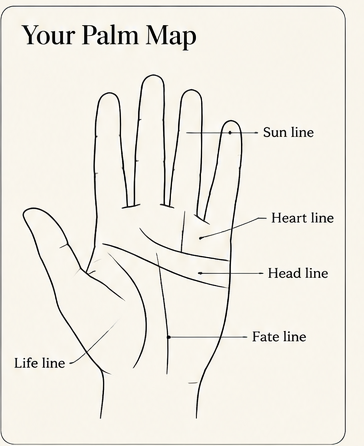
Hold your hand open, palm up, fingers relaxed. Four of the five lines show up on almost every hand; the fifth comes and goes. Here's each one — where it sits, what it covers, and how to read it.
Heart line — how you love
Where: the uppermost horizontal line, running under the fingers from the edge of the palm toward the index or middle finger.
What it covers: emotions, relationships, how you attach and how you express affection.
How to read it: a curved heart line (arching up toward the fingers) reads as expressive and warm — feelings worn openly. A straight one reads as rational and reserved — love shown through steadiness rather than grand declarations. Breaks or chains along the line are traditionally read as emotional turning points, not disasters.
Head line — how you think
Where: the next line down, crossing the middle of the palm roughly horizontally, starting near the thumb edge.
What it covers: thinking style, decision-making, communication.
How to read it: a straight, long head line reads as logical, focused, methodical. A curved or sloping one reads as creative and intuitive — someone who decides by leaps rather than steps. Depth matters as much as shape here: a deep line points to strong concentration; a faint one to a mind that ranges widely.
Life line — your energy
Where: the curve that sweeps around the base of the thumb, from between thumb and index down toward the wrist.
What it covers: vitality, energy, enthusiasm for life — and major life changes.
How to read it: first, the correction every practitioner makes on day one: a short life line does not mean a short life. It never did. The line is about quality — deep and clear points to steady energy; faint to energy that needs protecting. Breaks signal changes in circumstance or direction — moves, reinventions — not endings. A long, deep curve hugging the thumb reads as rootedness; a wide swing out into the palm as restlessness and a big appetite for life.
Fate line — your direction
Where: a vertical line running up the center of the palm toward the middle finger. Not everyone has a clear one.
What it covers: career, life direction, how much outside circumstances steer you.
How to read it: a strong, unbroken fate line reads as a life with a clear through-line — one calling, followed steadily. Breaks mean career shifts and changes of direction. And the counterintuitive part: no visible fate line at all is traditionally a good sign — a self-determined path, with no one steering but you.
Sun line — your gifts
Where: a vertical line toward the ring finger, roughly parallel to the fate line. The rarest of the five.
What it covers: creativity, recognition, the moments people notice you. Sometimes called the line of fame.
How to read it: a clear sun line reads as talent that finds an audience. Many hands barely show one — practitioners read that as recognition arriving late or quietly, not as a lack of talent.
Reading depth, length and breaks
Whatever the line, the same rules apply:
- Depth — deep and clear reads as strength in that area; faint as subtle or still developing
- Length — longer means the theme runs through more of your life
- Breaks — turning points and changes, not damage
- Forks and branches — the theme showing up in two forms (a forked head line is the classic "writer's fork": logic and imagination in one mind)
- Islands and chains — stretches when that part of life was rough or complicated
Beyond the lines: hand shape and mounts
Practitioners look at the hand's overall structure before the first line. The short version:
Hand shape comes in four types, named after the elements: earth (square palm, short fingers — practical), air (square palm, long fingers — intellectual), water (long palm, long fingers — intuitive), fire (long palm, short fingers — energetic). Your type is the temperament the lines play out against.
Mounts are the padded areas under each finger and at the base of the thumb, each named for a planet and read for how strongly that trait shows — a raised mount of Venus (the thumb pad) reads as warmth and appetite for life; a flat one as reserve. Beginners do better starting with the lines and saving the mounts for later.
How to read your own palm, step by step
- Relax the hand. Let it cup slightly, fingers loosely apart. Don't stretch it flat — tension hides the fine lines.
- Find soft, even light. A window in daylight or a room lamp. Skip harsh flash and strong backlight, which wash the lines out.
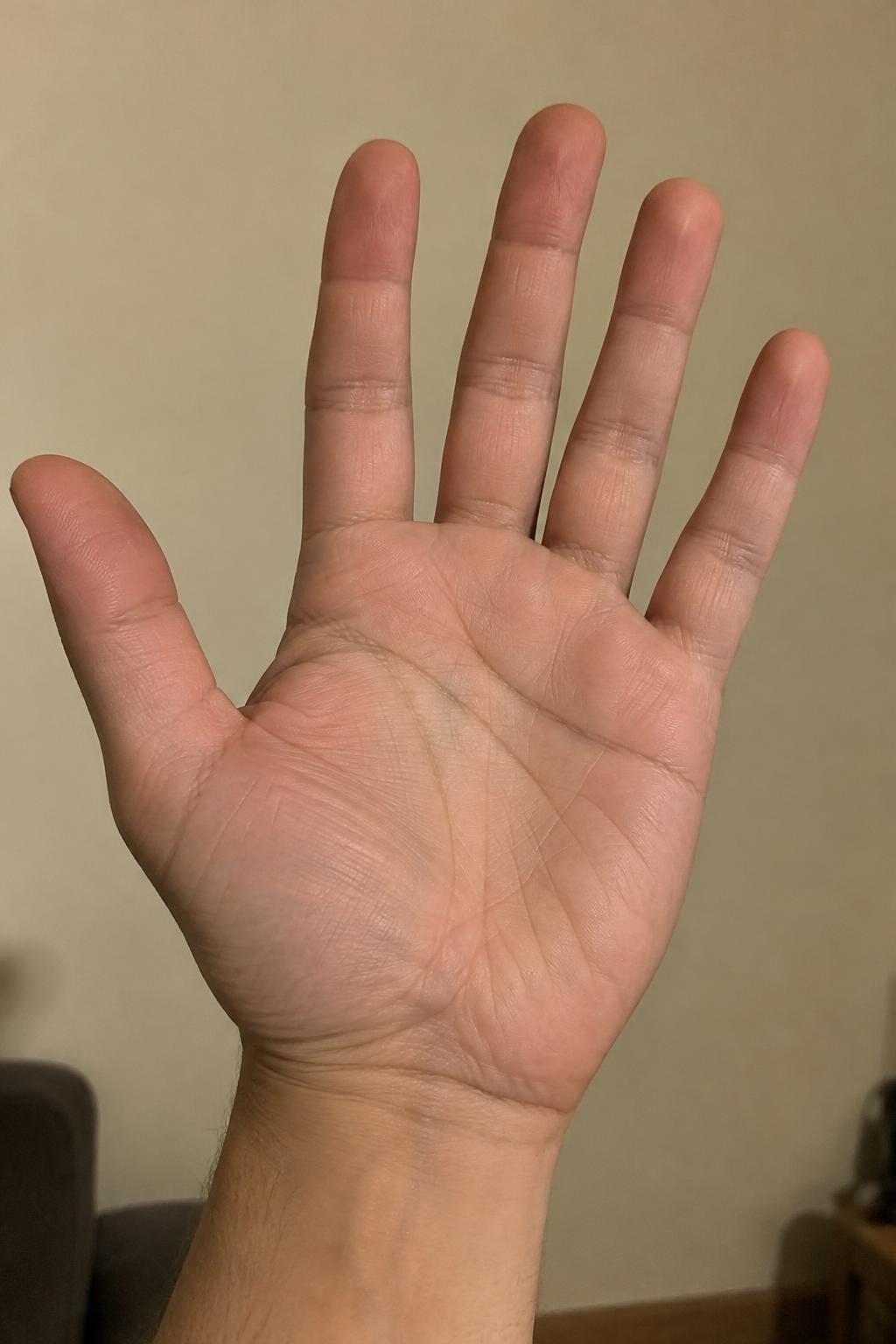
- Find the major lines first. Heart, head, life. They're the deepest grooves on almost every hand. Then look for the fate line, then the sun line.
- Read depth and length before detail. Get the big picture of each line before hunting for forks and islands.
- Compare both hands. Dominant for "now," non-dominant for "nature." The differences between them are the most interesting part of the reading.
The shortcut: have your palm read from a photo
Everything above, you can do yourself with a mirror and ten minutes. But if you want the full reading without studying the chart — or you want it in another language — there's a faster path.
Our palmistry tool reads your palm from a single photo: one open palm facing the camera, filling most of the frame, fingers relaxed. It traces the lines actually visible on your hand and gives you an annotated reading — heart, head, life, fate and sun, one by one, explaining what each says about how you love, how you think and where your energy goes. The reading comes back in any of forty languages, as a keepsake card with your own palm on it.
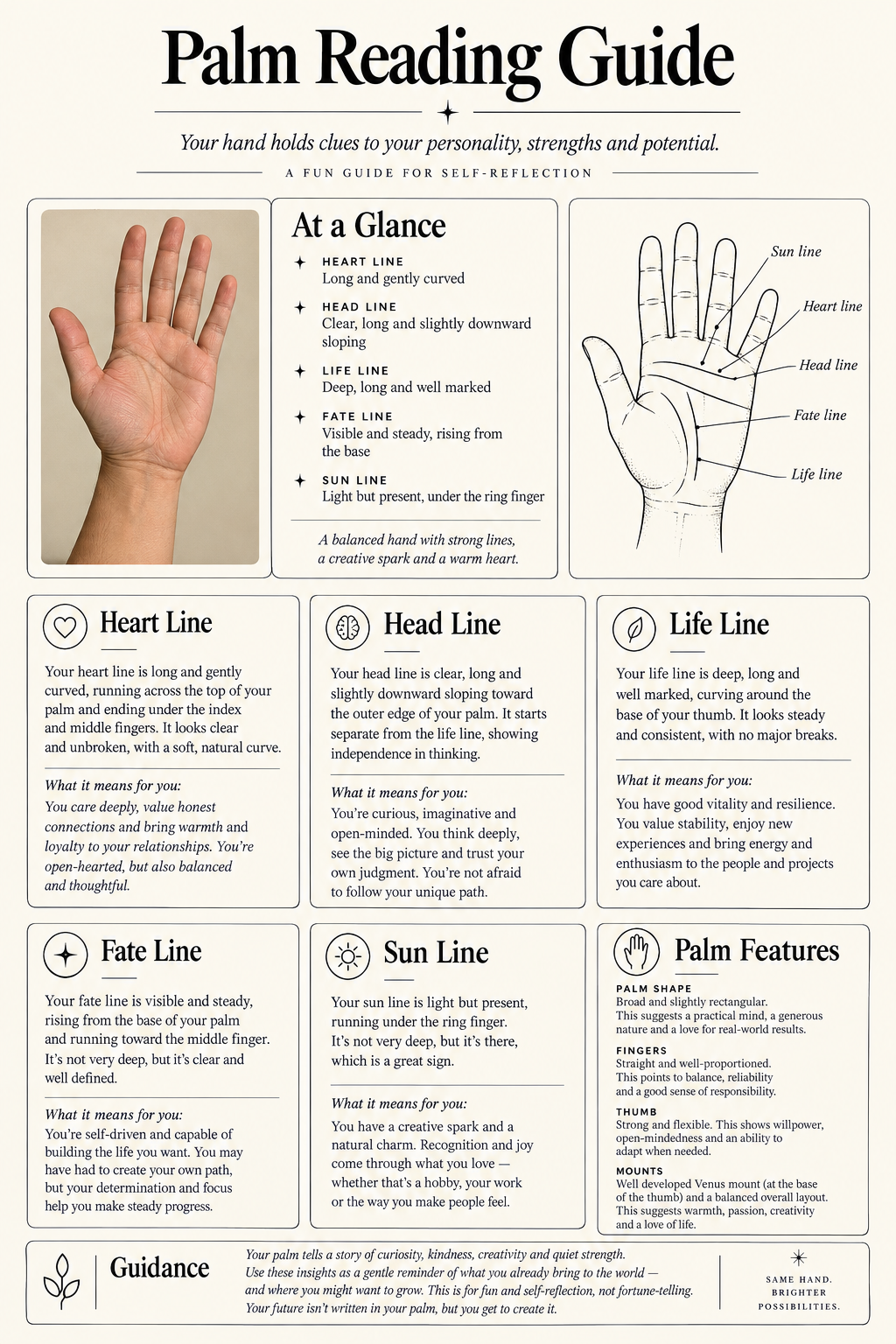
Two honest notes, the same ones we give on the tool page. The lines in your reading are traced from your actual photo — the artwork is genuinely yours. And the reading itself keeps to the tradition's proper boundaries: a mirror and a conversation starter, never a forecast. It will never predict death, illness or misfortune.
A reading costs a few credits — the exact price shows up before you submit, and a failed reading is refunded automatically.
FAQ
Is palmistry a real science? No — and honest practitioners have never claimed otherwise. It's a tradition for reflection, self-knowledge and fun, with three thousand years of cultural history behind it. Treat a reading as a mirror: often surprisingly resonant, never a prediction.
Left hand or right hand? Both work. Read your dominant hand for your current path and your non-dominant hand for your innate wiring — comparing them is half the point. If you're only reading one, pick the dominant one.
What does a broken life line mean? A change, not an ending. Practitioners read breaks in the life line as shifts in circumstances or direction — a move, a reinvention, a new chapter. The idea that a short or broken life line predicts a short life is the myth practitioners correct more than any other.
Do palm lines change over time? Practitioners say yes — the fine lines especially can shift over the years, which is one reason the two-hand comparison matters. The major lines stay stable enough that a reading today and a reading next year will agree on the essentials.
What if I can't find my fate line or sun line? Normal. The fate line is faint or absent on many hands — read as a self-determined path. The sun line is the rarest of the five. A missing line is information, not a defect.
Ready to see what your own hand says? Get your palm read from a photo — or try AI palm reading, the same tool under a more everyday name. One photo, five lines, forty languages.